How Can Hospitals Use RCS Messaging?
Every day, hospitals lose money and trust due to three common occurrences: missed appointments, unanswered follow-up texts, and ignored health alerts. The simplest message sent by an anonymous number cannot possibly be trusted. It comes with no name, no branding, and even lacks a response method.
RCS messaging takes care of this problem by offering hospitals a new way to communicate interactive messages right to their phones, without any additional applications to install. Here is how RCS messaging for hospitals works in practice.
What RCS Messaging Means for Hospitals
RCS is short for Rich Communication Services, an advanced version of SMS that runs within the native messaging app on Android phones. From the hospital's point of view, the important differences lie in trust and functionality.
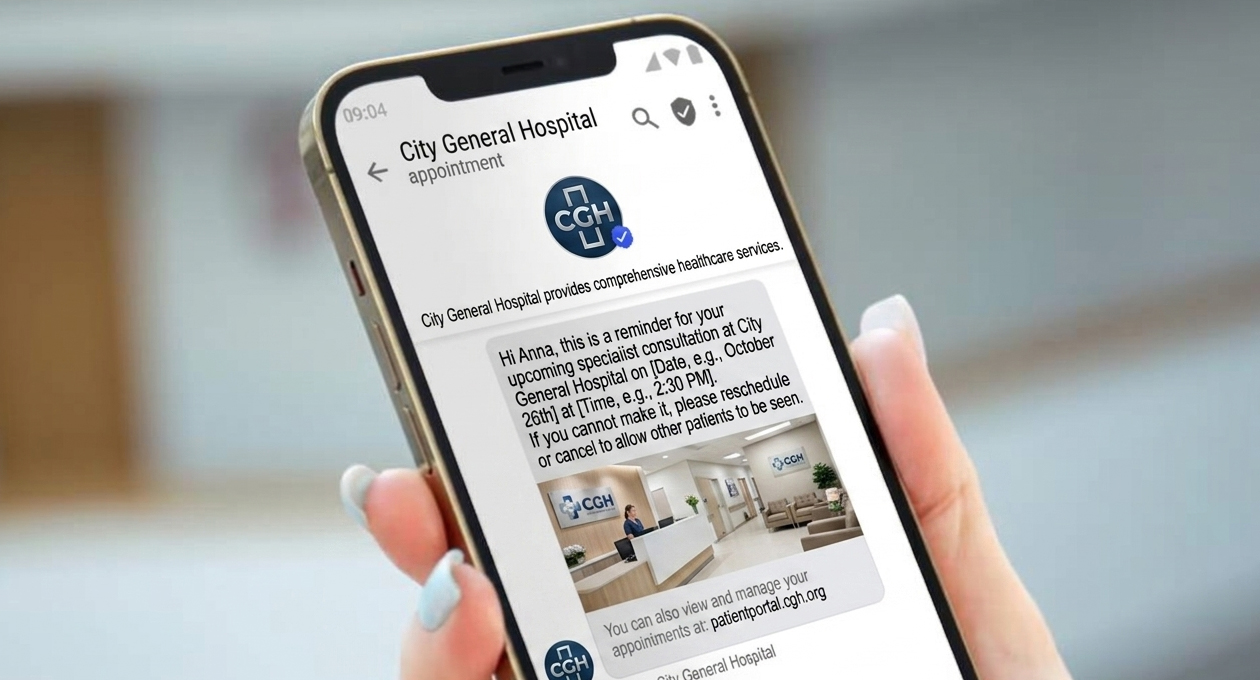
With RCS, your hospital name, logo, and badge come along with all messages to patients. Images, files, and button actions can be sent using RCS. Patients can easily respond and give instructions without having to visit the front desk. If the team uses RCS , it becomes easy to communicate with patients directly.
8 Use Cases Where Hospitals Use RCS Messaging
Starting from appointment reminders to follow-up after discharge, hospitals are discovering tangible means of leveraging healthcare RCS messaging through all stages of patient care.
Appointment Reminders with Confirm or Reschedule Buttons
Send a reminder two days prior to the appointment and another one hour before. Place the "Confirm" and "Reschedule" buttons. Patients click one time. You get an instant notification of their response. Reduced number of no-shows and cancellations.
OTP and Patient Verification
Use RCS-based messages for OTP purposes during logins to patient portals and for identity verification during teleconsultations. A branded and verified message holds more credibility than a standard OTP-based SMS.
Discharge Summaries and Post-Care Instructions
Send discharge notes, drug regimens, and wound care instructions through text or PDF files. This gives the patient information to review and caregivers access to the same information as well.
Medicine and Prescription Reminders
Schedule reminders for the medications that patients need to take following surgery or for chronic conditions. Provide details on how much to take and when, and allow them to schedule refills directly from their reminder.
Lab Report and Test Result Notifications
When results become available, you can send a notification with an encrypted link or a summary. No need for patients to call the hospital just to confirm. In routine testing procedures, this alone will make a big difference.
Health Camp and Wellness Program Promotions
Advertise your health camps, medical checkup campaigns, and vaccination programs through rich media messages that will allow people to register with ease. RCS messages resemble authentic hospital messages rather than spam, hence higher opening and registration rates.
Doctor Availability and Slot Booking
Provide your available time slots in the message itself, letting the patients choose and book their slot through the discussion. This will eliminate the process of calling the hospital's reception desk and save time for all.
Feedback and Patient Satisfaction Surveys
Following a visit or consultation, use an RCS survey to get feedback. The response rate for RCS surveys is much higher compared to SMS surveys since patients can respond without exiting their messaging app.
Why RCS Works Better Than SMS for Hospitals
The fundamental problem of using SMS in hospitals is that it is asking patients to trust an unknown number. It is impossible to prove who exactly has sent this message, and people have long ago learned to distrust any medical information that appears in SMSes.
RCS deals with this concern head-on. Your hospital's name and logo are featured prominently on all messages. The badge proves the sender's status as a legitimate hospital. People will be far more inclined to open and reply to a hospital's message that they recognize.
In addition to trust, RCS facilitates two-way communication. The patient can rearrange their appointment, verify the information, or even ask for clarification on the same platform. This translates to results for hospitals such as reduced no-shows, increased efficiency, and enhanced discharge compliance rates. Rich messaging is not only more attractive but also more efficient.
How to Start Using RCS for a Hospital
Starting out with RCS messaging for hospitals is straightforward with a few simple steps:
- Ensure that your hospital signs up as an authenticated RCS sender via an authorized RCS partner.
- Create authenticated message templates for reminders, OTPs, and discharge summaries.
- Integrate your RCS solution with your Hospital Management System or Customer Relationship Management (CRM) system.
- Perform testing of messaging flows around appointment booking, laboratory notifications, and feedback gathering before implementation.
- Ensure training of your front desk and patient engagement staff to respond to messages.
How RCS Brand Rise Helps Hospitals with RCS Messaging
RCS Brand Rise partners with you directly at the hospitals for all of the setup processes involved, including sender approval and campaign setup. They will also manage your template approvals, HMS integration, and other support services, so your hospital can focus solely on providing patient care. With a single or multi-facility system, we will ensure that you have all that you need to start communicating via RCS communication for hospitals immediately.
Closing
Missed appointments, ignored notifications, and non-personalized follow-ups are issues that confront hospitals on a daily basis. Through RCS , hospital personnel can solve all three of those issues through communication that is not only guaranteed but also customized.
In addition, it uses the phone's built-in messaging app, does not require an application download, and produces better results than regular SMS. This is the ideal first step for any hospital that wants more patient engagement.
FAQs
1. What types of hospitals can use RCS messaging?
Any hospital, diagnostic center, or multi-specialist clinic that uses mobiles to communicate with its patients can employ RCS. It is equally applicable to hospital chains that have thousands of appointments to handle every week, as well as smaller hospitals looking to minimize manual efforts.
2. Is patient data safe with RCS messaging?
The messages sent using RCS in compliance with the system's protocols are bound by data privacy protocols. The hospitals must collaborate with a registered RCS company that complies with the data regulations and encrypts the messages.
3. Do patients need to download a new app to receive RCS messages from a hospital?
No. RCS uses the native messaging application in Android smartphones. In case a patient's phone does not have the capability to send an RCS message, then the message will be sent via SMS.
4. Can RCS actually reduce missed appointments at hospitals?
Yes. If you give a patient a reminder with options like Confirm/Reschedule that require only one tap, response rates will be higher than with SMS. Hospitals adopting RCS technology in sending out appointment reminders have reported lower no-show rates in the initial months of adoption.

We are restructuring the way the business in Delhi interacts with the customers at RCS Brand Rise. We are the market leader and the RCS provider of Delhi in India, specialised in smarter, richer, and more interactive messaging.
Quick Links
© 2025 RCS Brand Rise. All Rights Reserved.